
The Vuylbeek is a well-known stream of the Forest; its valley is beautiful and its history long. The name ‘foul stream’ is believed to be a reflection of the rusty staining of parts of its bed. As early as the 8th century there was small-scale iron ore smelting in many locations in the Forest using naturally occurring limonite. There was water, there was charcoal.
It’s not the only stream to carry this name, there is an apposite echo, though not obvious.
The Ijse rises by the Chaussée de Waterloo, near the Parking at Middenhut and ‘flows’ through the Forest, watering the lakes at Groenendaal and empties into the Dyle near Huldenberg, naming Upper and Lower Ijse on the way (Overijse and Neerijse).
Its name could link to a pre-Germanic river name, 𝐸𝑖𝑠𝑖𝑘𝑎̄, meaning roughly ‘the copper-coloured stream’ or, in Dutch, as 𝑑𝑒 𝑟𝑜𝑒𝑠𝑡𝑖𝑔𝑒 𝑏𝑒𝑒𝑘 or the rusty stream. Iron smelting sites dating to the 8th and 9th centuries have been excavated in Hoeilaart.
Tomorrow I shall continue the Odyssey: the stream deserves its moment in the sun.
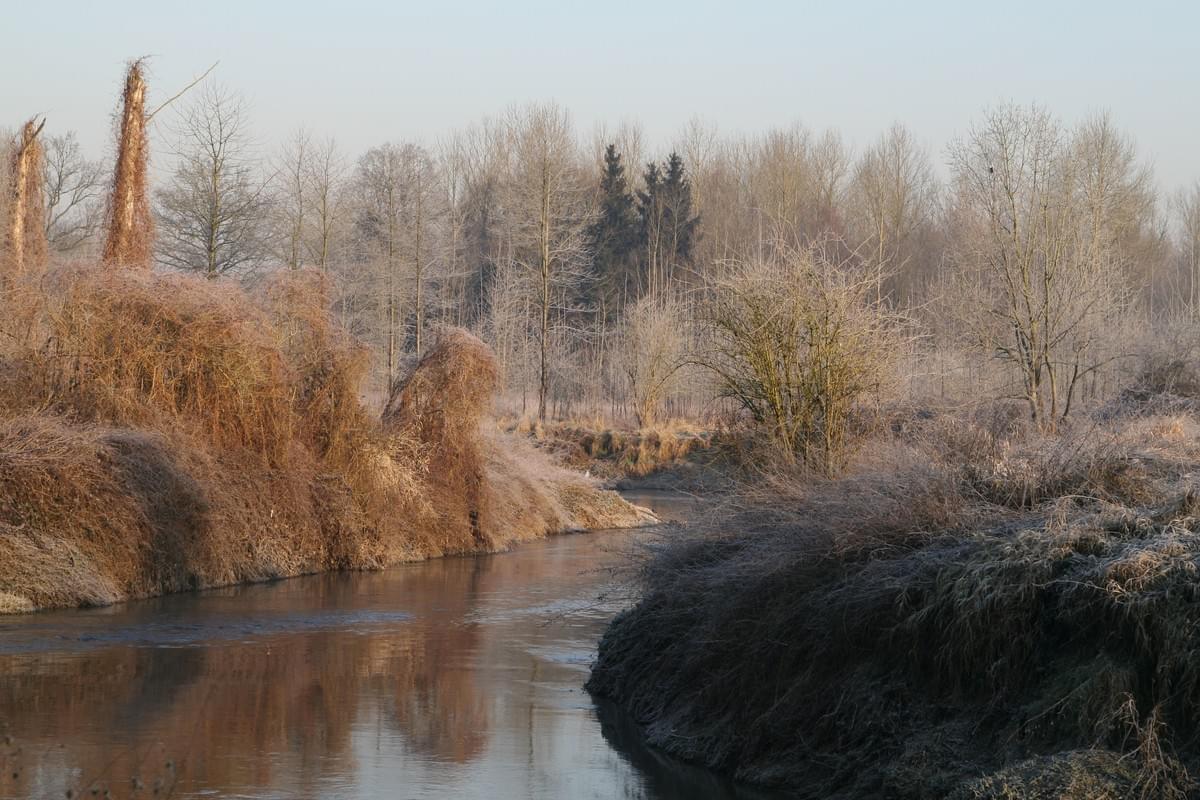
The IJse meets the Dyle at Neerijse. Photo by Janter, Wikimedia Commons, CC BY-SA 3.0.