
𝐀̀ 𝐥𝐚 𝐒𝐚𝐢𝐧𝐭-𝐌𝐚𝐫𝐭𝐢𝐧, 𝐥'𝐡𝐢𝐯𝐞𝐫 𝐞𝐬𝐭 𝐞𝐧 𝐜𝐡𝐞𝐦𝐢𝐧.
Today is Armistice Day, the 11th of the 11th and unlike in the United Kingdom it is a holiday in Belgium, and rightly so: this small country has seen much death in conflict. It’s so well known that other remembrances can and do take second place; again, possibly rightly so.
Today is the Feast Day of Saint Martin of Tours (c. 316-397) and, in Overijse, a fine, large church named for him stands on an elevated site above the village square, surrounded by remnants of its former churchyard.
It dates back to at least 1141, when it was first mentioned in a charter of Godfrey III, Duke of Brabant. Which got me thinking.
How much of the rusty stream I wrote about yesterday, the IJse, actually flowed through the Forest, before emptying into the Dijle near Huldenberg?
Today it flows through Groenendaal, under the Ring, and, after passing through several ponds, enters Hoeilaart. The 𝑔𝑒𝑚𝑒𝑒𝑛𝑡𝑒 of Hoeilaart contains a large portion of the Forest and buildings of the town border it. The topography of the area feels like the Forest, denuded by trees, and this continues to Overijse. Take a drive from Groenendaal through to Overijse and see.for yourself. Continue to Huldenberg.
I chanced upon this following passage in Sandor Pierron’s 𝐻𝑖𝑠𝑡𝑜𝑖𝑟𝑒 𝑑𝑒 𝑙𝑎 𝐹𝑜𝑟𝑒̂𝑡 𝑑𝑒 𝑆𝑜𝑖𝑔𝑛𝑒𝑠 (1905). First comes the original French, then a translation.
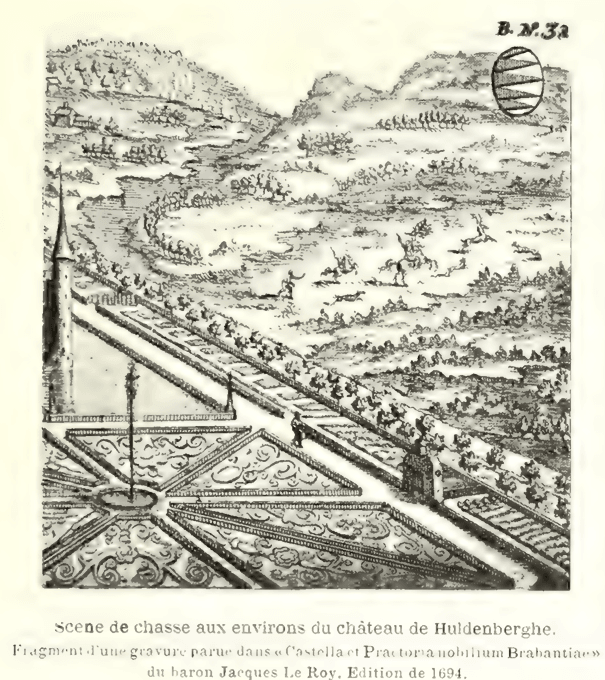
« Non loin d’Everberg on voyait le château de Huldenberg, appartenant à la maison de Ryckewaers, dans la mairie de Vilvorde ; ce château avait six tours d’égale hauteur.
[...]
Ce manoir, pur échantillon de l’architecture militaire du moyen-âge, a disparu vers la fin de la domination française. Il formait un carré de bâtiments symétriques, dont les quatre angles étaient fortifiés de tours. Sur les murailles se dressaient des tourelles. Le corps principal faisant saillie au-dessus de la porte d’entrée, était flanqué aussi de deux tourelles. Les jardins spacieux, agrémentés de pièces d’eau, s’étendaient à une grande distance ; ils se reliaient à des bois nombreux appelés dans leur ensemble Cleyn Sonien, ou Petite Soigne, parce que certains d’entre eux, baignés par les eaux de l’Yssche, se rattachaient à la forêt lointaine. »
Not far from Everberg stood Huldenberg Castle, which belonged to the house of Ryckewaers and lay within the jurisdiction of Vilvorde. The castle had six towers of equal height.
[...]
This manor, a fine example of medieval military architecture, disappeared towards the end of French rule. Its symmetrically arranged buildings formed a square, with a tower defending each of the four corners. Turrets rose above the walls. The main building projected over the entrance gateway and was itself flanked by two turrets. The spacious gardens, adorned with ponds, extended a considerable distance and merged into numerous woods known collectively as Cleyn Sonien, or Little Soignes. They bore that name because some of those woods, washed by the waters of the IJse, were linked to the distant Forest.”
So at least a tentacle of the Forest reached Huldenberg giving the IJse a place alongside other streams of the Forest, like the Woluwe, the Vuylbeek, the Wollenborre, the Bocq, the Karregat…
Tally ho!
The thing is, will we get a 𝑆𝑖𝑛𝑡-𝑀𝑎𝑎𝑟𝑡𝑒𝑛𝑠𝑧𝑜𝑚𝑒𝑟, an Indian summer? It really is a bit dreeg out there today.