
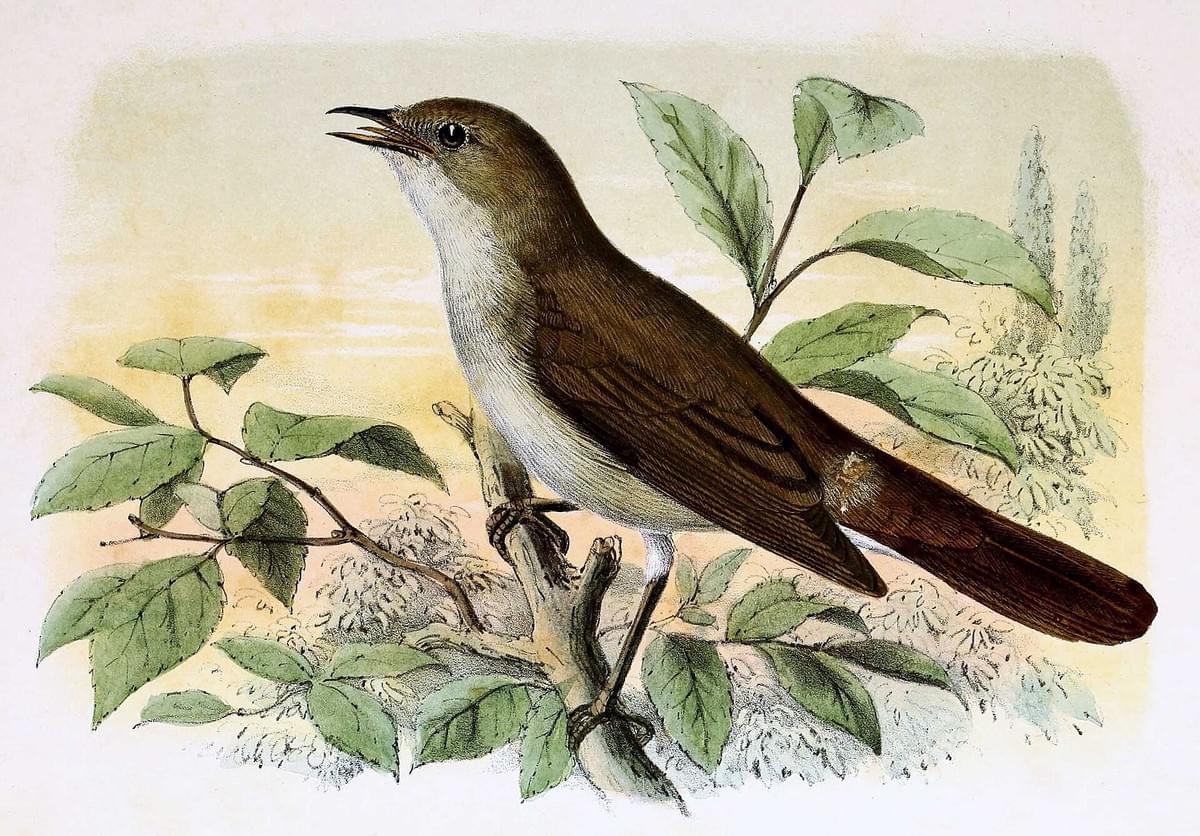
Le Rossignol chante généreusement, sans se ménager, car, hélas ! son temps est compté. Il garde le silence après deux mois à peine de chansons, nous laissant le regret du passé et le charme du souvenir enchanteur. Le Rossignol préfère les lisières, les clairières des bois, les taillis, les buissons à proximité des étangs et des ruisseaux, où il aime à se baigner fréquemment dans l’eau pure. Tous les mouvements du Rossignol sont empreints d’une certaine dignité. Il semble qu’il ait conscience de sa valeur. Il ne sautille pas de branche en branche et, quand il perche, il tient habituellement le corps droit. Les parties supérieures de son plumage sont d’un brun roux ; les côtés de la tête et du cou, la poitrine et les flancs sont cendrés, la gorge et le ventre blancs, la queue d’un roux vif.
EN version
The Nightingale sings generously, sparing himself nothing, for, alas! his time is numbered. After scarcely two months of song, he falls silent, leaving us with regret for what has passed and the charm of an enchanting memory. The Nightingale prefers the edges and clearings of woods, thickets and bushes near ponds and streams, where he likes frequently to bathe in the pure water. All the Nightingale’s movements are marked by a certain dignity. He seems conscious of his own worth. He does not hop from branch to branch and, when he perches, he usually holds his body upright. The upper parts of his plumage are russet-brown; the sides of the head and neck, the breast and flanks are ash-grey, the throat and belly white, and the tail a vivid russet.
Dr. Alphonse Dubois, conservateur honoraire au Musée d’Histoire naturelle de Belgique from La Forêt de Soignes, edited by Stevens and Van der Swaelmen, 1920
Image by John Gerrard Kuelemans, 1873