
𝐖𝐢𝐜𝐤𝐬 𝐨𝐟 𝐦𝐨𝐬𝐬
What’s happening on this stump is not competition in the usual sense. It’s cohabitation by temperament.
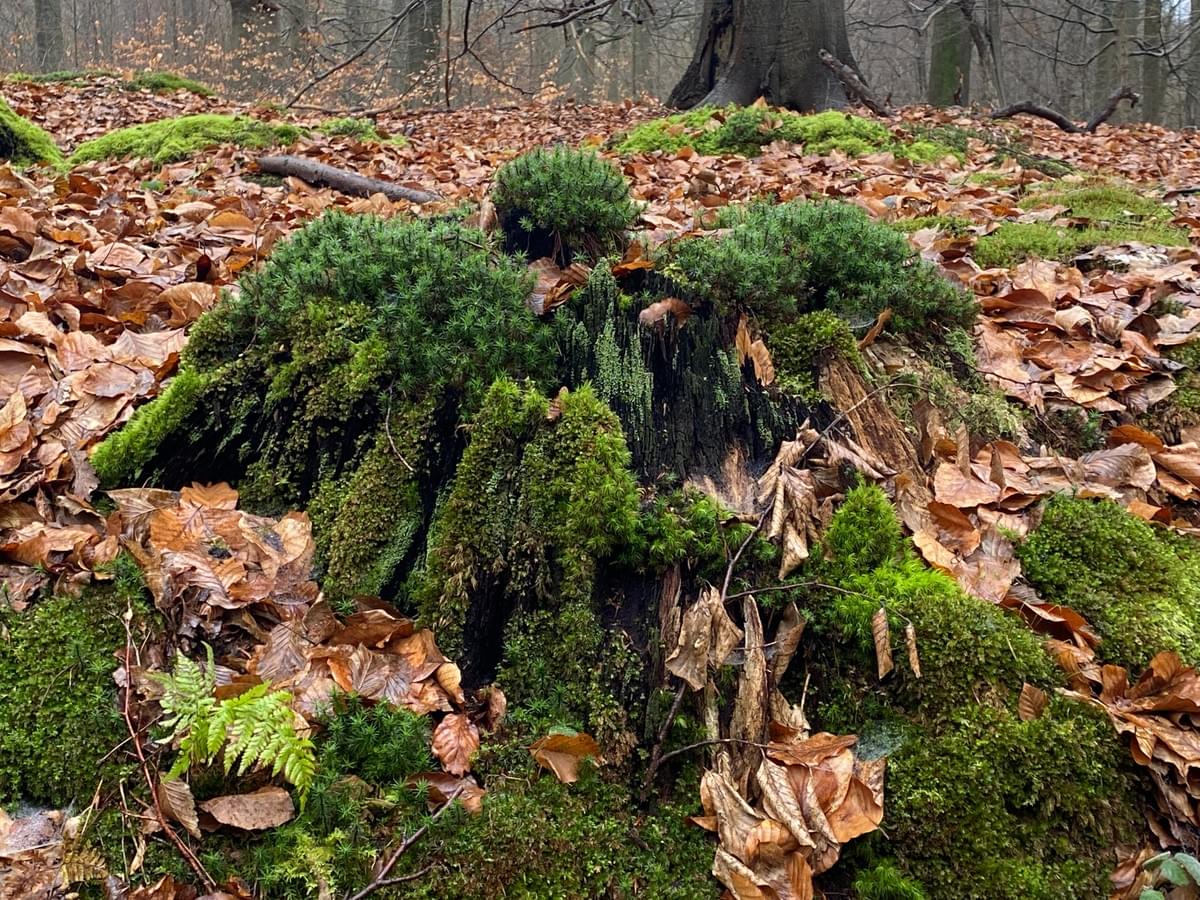
Each moss has found a way of being here without pushing the others out. The cushions hold the crown, where light is strongest and water drains quickly. They accept exposure, wind, the first touch of frost, surviving by density and resilience.
Below them, feather mosses do not try to climb. They spill. They drape themselves over the sides where moisture lingers and water runs rather than pools. They borrow the stump’s contours rather than resist them.
In the cracks and seams, finer mosses settle where neither cushion nor feather can quite manage. Too narrow, too shaded, too changeable. They live close to the wood itself, adjusting year by year as it softens.
No one claims everything. No one is excluded. Each moss reads the stump differently and answers in its own way.
What looks like overlap is actually partition. Light, moisture, angle, texture. Each variable nudges a different species into place. The stump becomes not a surface but a landscape.
There is time in this too. Some arrived early, others later. Some will persist, others will thin and retreat. None of them hurry. None of them seek dominance.A quiet lesson, perhaps, in how things last.
Not by winning space, but by fitting it.