
𝐈𝐟 𝐲𝐨𝐮 𝐠𝐨 𝐝𝐨𝐰𝐧 𝐭𝐨 𝐭𝐡𝐞 𝐰𝐨𝐨𝐝𝐬 𝐭𝐨𝐝𝐚𝐲…
𝐓𝐡𝐞 𝐦𝐲𝐬𝐭𝐞𝐫𝐢𝐨𝐮𝐬 𝐬𝐭𝐨𝐧𝐞(𝐬) 𝐟𝐫𝐨𝐦 𝐃𝐮𝐢𝐬𝐛𝐮𝐫𝐠 𝐏𝐚𝐫𝐭 𝐓𝐡𝐫𝐞𝐞
As my research continued I came across a detailed report from 1888 in the Bulletin of the Anthropological Society of Brussels p269-286, written and presented by Mr. D. Raeymaekers. I have summarised it as best I can, but should you like a copy leave me a reply to the post and I’ll send it to you.
Raeymaekers’s conclusion is that the three Duisburg stones are natural geological blocks, rather than the remains of a dolmen or sacrificial altar. His report, presented in 1888, examines their discovery in 1883 and challenges the stories that quickly grew around them.
They were discovered separately. Farmer J.-B. Nootens uncovered the first on 2 May, the second on 5 May and the third on 17 May. They lay several metres apart. Neighbours helped move them on wooden rollers to a nearby walnut tree.
They are Landenian sandstone, a rock found elsewhere in the region. Raeymaekers records comparable large blocks around Leuven, Vossem, Leefdaal and beyond. He considers the second and third stones to have been lying naturally within the gravel beneath the loam. He discusses ancient water currents, possibly carrying ice, as ways such blocks could have been displaced.
The first stone had probably been disturbed previously. Unlike the other two, it lay within the loam. He proposes that quarrying or woodland clearance had exposed it, after which someone buried it again because it obstructed cultivation. These are hypotheses, not established events.
Its inscription was recent. He dismisses the cross and letters as modern graffiti. A local boy was actually caught cutting the letter R more deeply.
There was archaeological material nearby, but it was distinct from the three large stones. Fragments recovered from an ash pit could be fitted together into part of a polished sandstone slab, approximately one metre long. He identifies this as probably a Neolithic polishing stone. A flint borer was also found, but he considers it unhelpful for dating the deposit. He suggests the ash pit itself could have belonged to comparatively recent woodcutters.
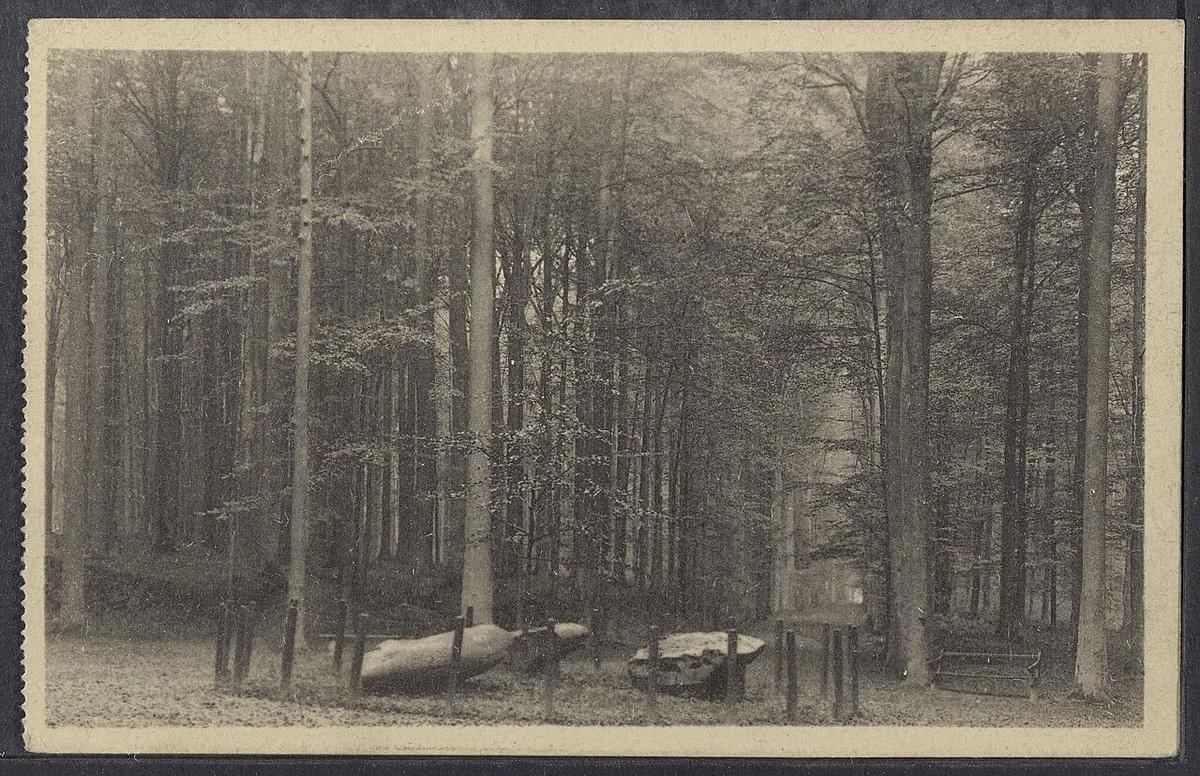
He rejects the proposed Druidic monument. Newspaper accounts had variously proclaimed a meteorite or an altar for human sacrifice. He finds no convincing evidence that the three blocks formed a dolmen, a stone table or a broken sacrificial altar. He does not document an attempt to fit the three together.
So there we are, a stone in three parts that may have once been whole (go and have a look, it seems plausible), no closer either to knowing whether the stone was ever used or why it took pride of place in the Royal Park. All I can do at this point is to hypothesise a little. Maybe Leopold II, with the International Exhibition of 1897 looming, saw them as useful. The Exhibition was on two sites, one being in Tervuren. Indeed, the Palais des Colonies, now the Africa Palace, was built especially for this, to showcase the artefacts and cultures of the Congo Free State, then under Leopold’s personal rule. Perhaps a mysterious stone, supposedly ancient, undeniably discovered a few kilometres away, could vouch for Belgium’s antiquity, in the absence of grand surviving monuments from the classical world. Leopold may have wanted to present Belgium, far from being a modern construct, as having roots stretching back through the millennia.
Perhaps the truth will never, unlike the stones, resurface.
Postcard published by Thill, Brussels, c. 1925. KU Leuven Libraries, GP068476, via Wikimedia Commons.
Title: Tervuren. Le Parc. Les pierres druidiques - De druidische steenen - The druidical stones