
𝐀 𝐭𝐡𝐨𝐫𝐧𝐲 𝐪𝐮𝐞𝐬𝐭𝐢𝐨𝐧
Wild Boar left the Forest by 1917, whether by over-hunting or too much wood-cutting by the occupying forces (or both) is open to discussion. They were next recorded during the winter of 2006, perhaps coincidentally (or not) after a rather severe snowstorm.
Sightings have been on and off during the intervening years, and, just a couple of days ago, a friend of mine had his usual camera in hand at dusk.
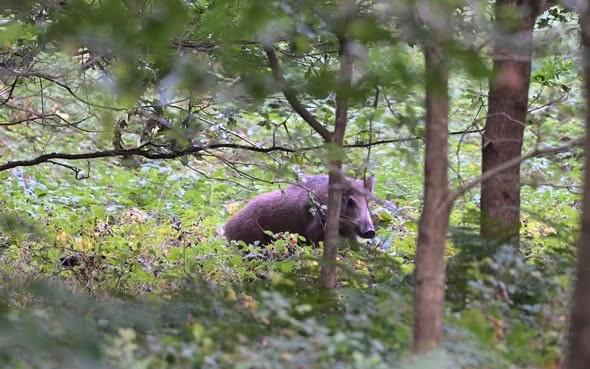
There don’t seem to be any places in the Forest named after them, deer are mentioned, polecats get a shout-out and hunting-terms abound a-plenty.
But the Sanglier, not.
I turn to Sander Pierron. In his Histoire de la Forêt de Soignes (1905) he presents the wild boar as one of the great animals of the ancient forest. According to him, the primeval Sonian Forest was home to the aurochs, bear, elk, wolf, lynx, red deer, roe deer and wild boar. What days those must’ve been!
He also describes how numerous the boar once were. By the eighteenth century, the surrounding villages were complaining that their fields were being devastated by "the abundance of deer, wild boar and other large wild animals". Later, however, the pendulum swung in the opposite direction. Following the French invasion of 1792, hunting was effectively thrown open, and Pierron writes that the game animals were slaughtered on a huge scale until the forest was almost empty.
The boar certainly had been making a real nuisance of themselves, destroying crops and agricultural land like ancient rotovators. And they were physically dangerous, particularly around their young, the marcassins.
Hedges containing blackthorn, hawthorn, rose and bramble were grown around dwellings to be a natural deterrent. It is thought to be from the French ‘épine’ or ‘thorn’ that we have the three ‘Espinettes’ along the Chaussée de Waterloo, although the middle one has no great history being a tram stop between the two long-established Espinettes.
So, do we really want them back? Bears, lynx and aurochs? Wolves?
Photos by Bernard Goyens de Heusch